CareStrong
A daily log for family caregivers of a person with dementia — so the invisible work of care, grief and coping doesn't disappear into one long blurred week.
1 Alzheimer's Association (2023). 2023 Alzheimer's Disease Facts and Figures. Family caregivers of people with Alzheimer's and other dementias provide an average of around 27 hours of unpaid care per week — the equivalent of a second job.
The problem
You are doing the job of several professionals at once. You are reorienting, redirecting, dressing, feeding, calming, keeping them safe, making medical calls between all of it. And the person you are doing it for mostly cannot remember that any of it is happening.
Because the disease is progressive, nobody tells you that your caregiving is working. There is no report card. There is only you, quietly absorbing loss and still showing up tomorrow — and the slow conviction that nothing you do is changing anything.
The hours you spend rephrasing the same sentence, redirecting the same worry, calming the same fear ten times in an afternoon — none of it shows up anywhere. There is no pay stub, no performance review, no progress chart.
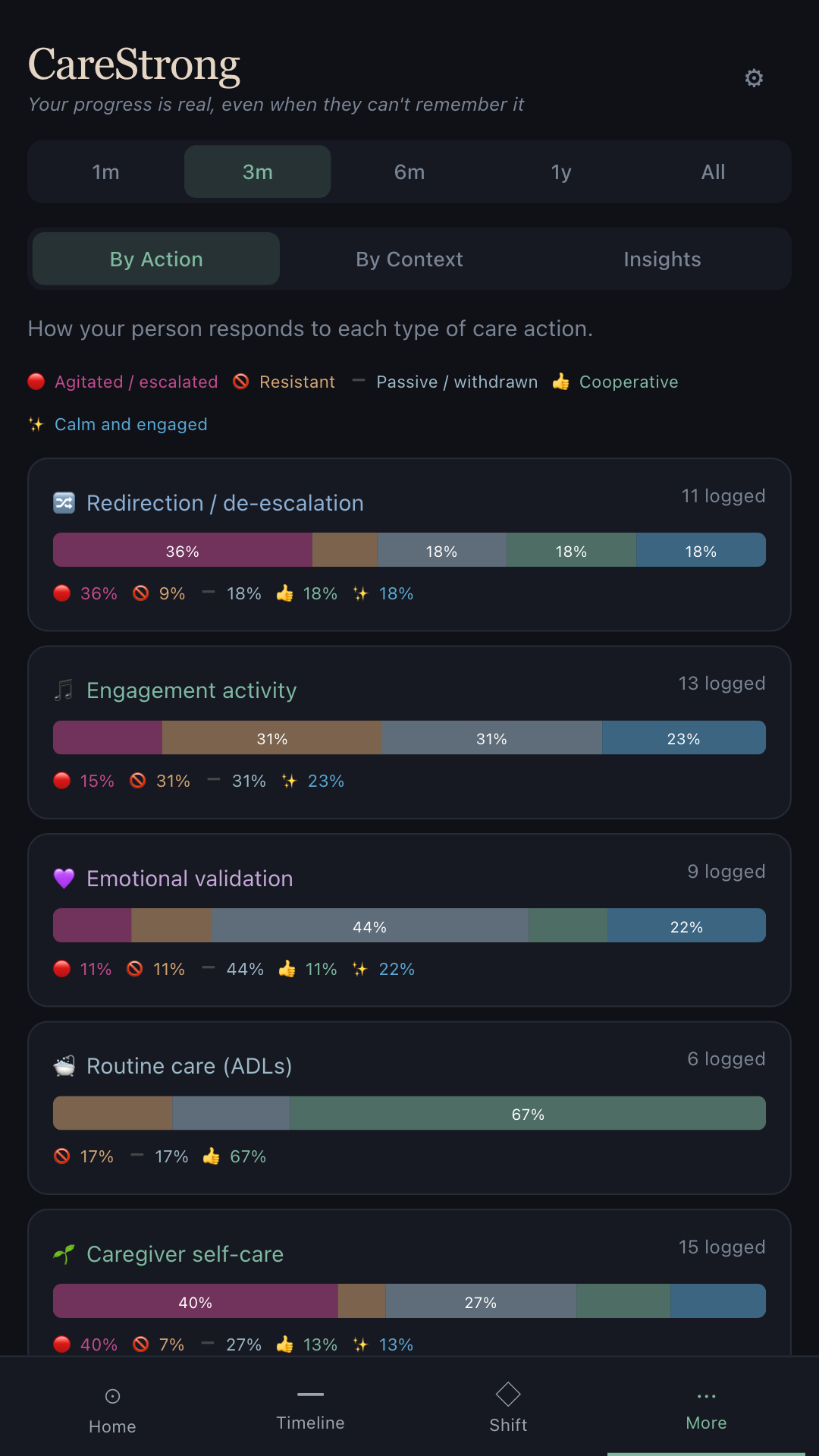
The Timeline turns your daily check-ins into a trend line across weeks and months. You'll see your care strategies, your own wellbeing, and the hardest parts of each week laid out as something you can actually look at — not a fog your memory keeps rewriting.
You've tried a dozen ways of handling the evening agitation, the bathroom resistance, the repeated questions. On a calmer day, you don't know whether it was your approach, the weather, the medication, or nothing at all.
The Pattern Engine cross-references your daily entries to reveal which inputs correlate with calmer days. Example insights might look like "agitation is lower on days with a protected afternoon routine" or "your own mood dips on days after two wake-ups" — all from your own logs.
In dementia care, decline is not a sign that you did the wrong thing. But every instinct says otherwise. When a harder week comes, it can feel like proof that your effort is worthless — it isn't.
Perspective Shift cards deliver short reframes rooted in dementia care research. Each card pairs what you're feeling with what the literature and clinicians actually say about progression, grief, agitation and the limits of what any caregiver can prevent. The frame never promises a cure — it gives you back the ground you're standing on.
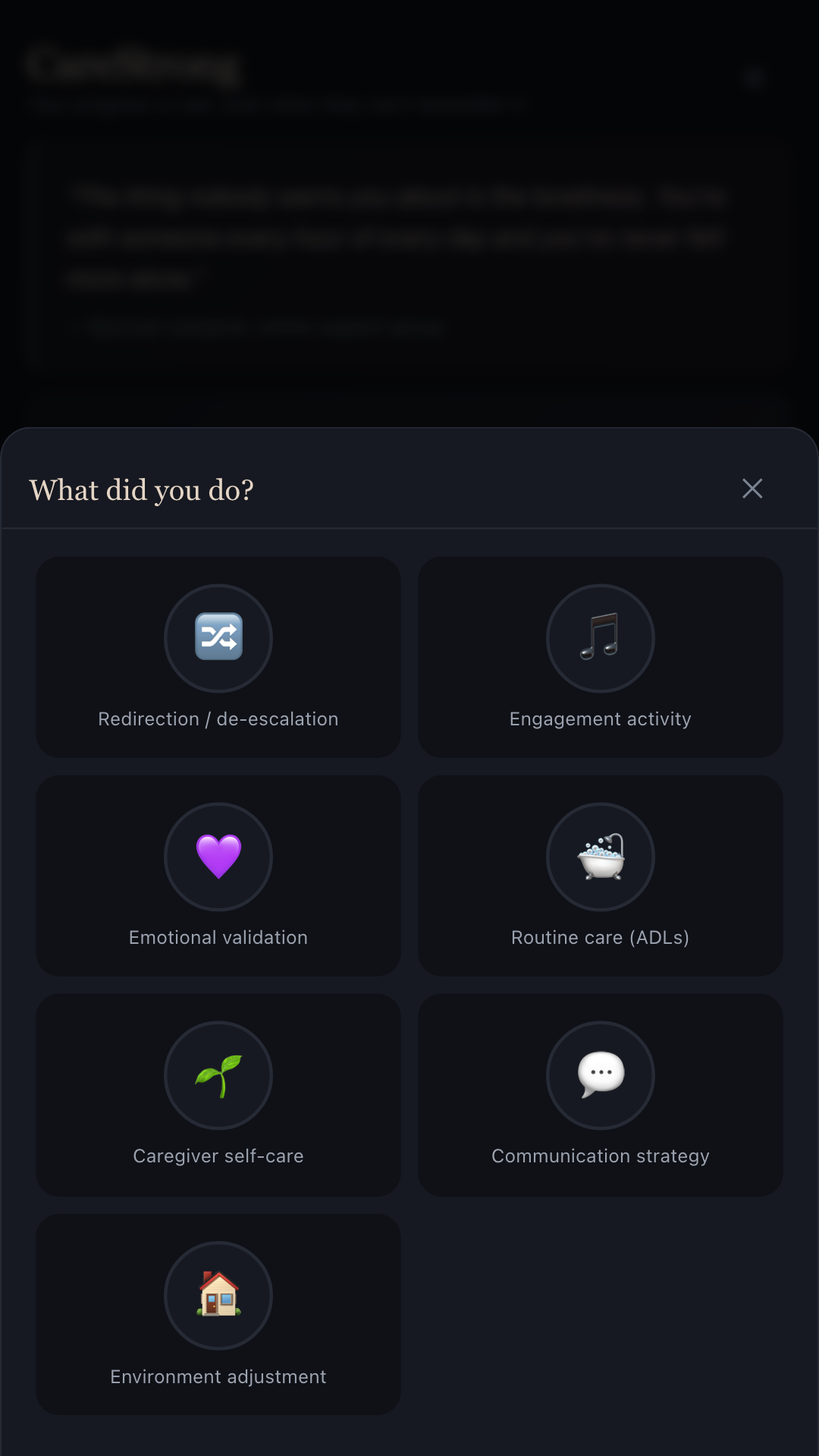
There is no room for another form to fill out. The daily check-in takes 30 seconds. A handful of sliders, an optional one-line note, and you're done for the day.
The Daily Log is designed for caregivers running on empty. No journaling, no essays, no obligation to be eloquent. Rate a few dimensions and move on. Those 30 seconds power the Timeline and the Patterns, and give you a picture you can share with family or the GP.
Fast enough for the nights you can barely stand up. That's how trends get built.
No promises of improvement. Just visibility for the work you are doing.
All data stays on your device. No accounts, no servers, no analytics.
CareStrong is for the family caregiver doing the daily, unpaid work of dementia care — the person whose effort nobody else is counting.
{{^app.live}}Coming soon to Google Play
{{/app.live}}