FocusStrong
A daily log for parents of a child with ADHD — so you can see whether your routines, your co-parent alignment and the medication are moving things in the right direction.
1 Wolraich, M. L., Hagan, J. F., Allan, C., Chan, E., Davison, D., Earls, M., et al. (2019). Clinical practice guideline for the diagnosis, evaluation, and treatment of attention-deficit/hyperactivity disorder in children and adolescents. The American Academy of Pediatrics recommends behavioral parent training as first-line treatment for preschool-aged children with ADHD, and as a core component of treatment for older children.
The problem
You have tried the visual schedule. You have tried the sticker chart. You have tried the calm voice, the loud voice, the no voice. Some days the morning works. Most days it doesn't. And after a hundred versions of Tuesday, you genuinely cannot remember which approach was the one that finally stuck.
When you can't see the trend, you keep switching strategies. Your child never gets long enough on any one system to settle into it. And the quiet truth — that a lot of what you're doing is actually working — gets lost in the noise of one exhausting week.
ADHD parenting strategies work in small, uneven ways. A morning that is 15% less chaotic. A homework session that only blew up once. Day to day it looks like failure. Over a month the slope is real.
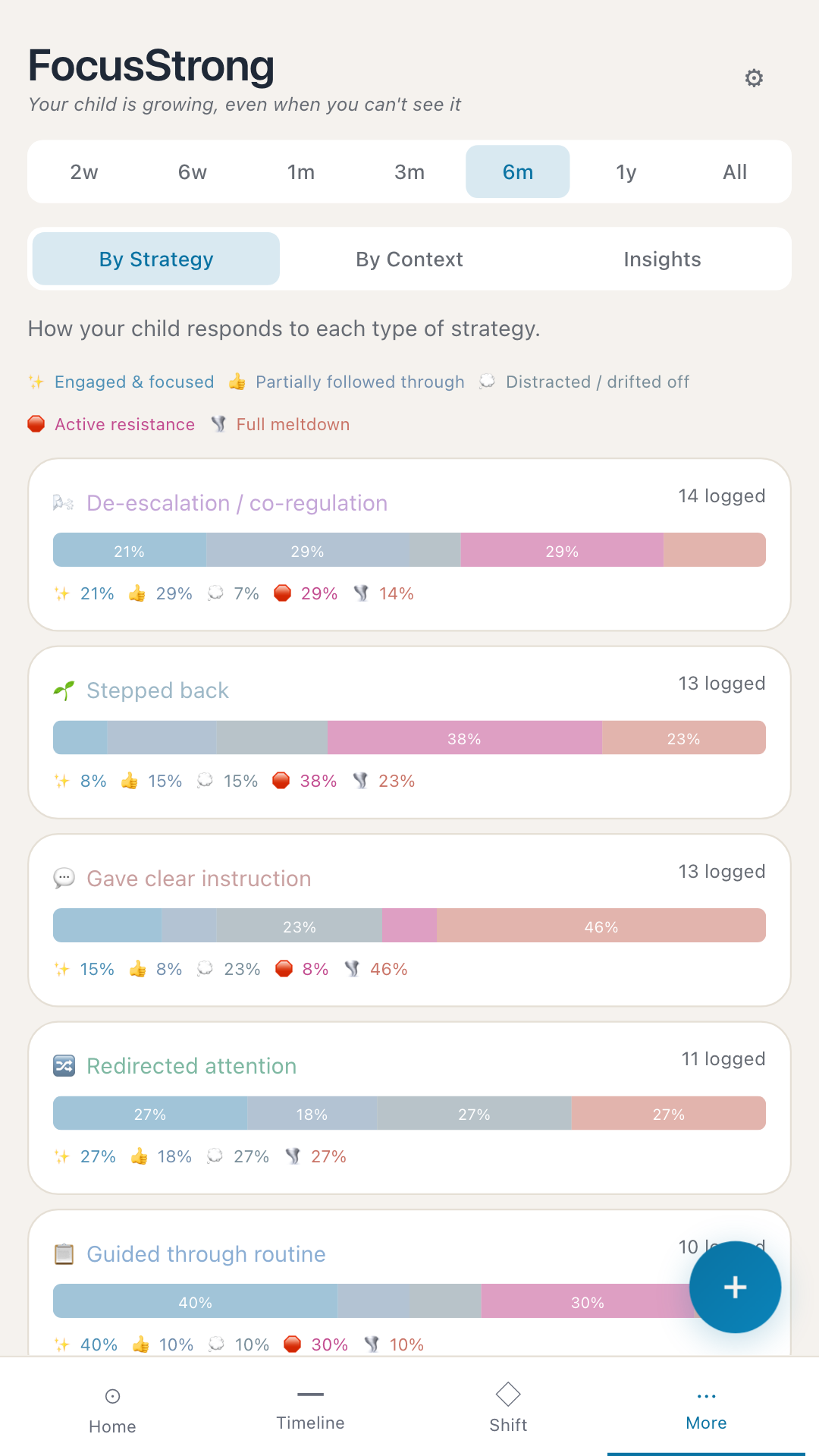
The Timeline turns your daily check-ins into a trend line across weeks and months. You'll see whether routines, behaviour and the medication plan are moving in the direction you hoped — so you can stop switching approaches every time you have one bad day.
Between sleep, screens, snacks, meds timing, visual schedules and consequences, there are too many variables to hold in your head. When a morning goes well, you don't know which piece earned it.
The Pattern Engine cross-references your daily entries to surface which inputs correlate with smoother days. Example insights might look like "homework is easier on days the morning started with protein" or "meltdowns are higher the day after late bedtimes" — drawn from your own data.
When you're six steps into the same instruction and nothing has happened, it looks like defiance. The ADHD brain is doing something else. Holding that in mind during a hard moment is almost impossible without help.
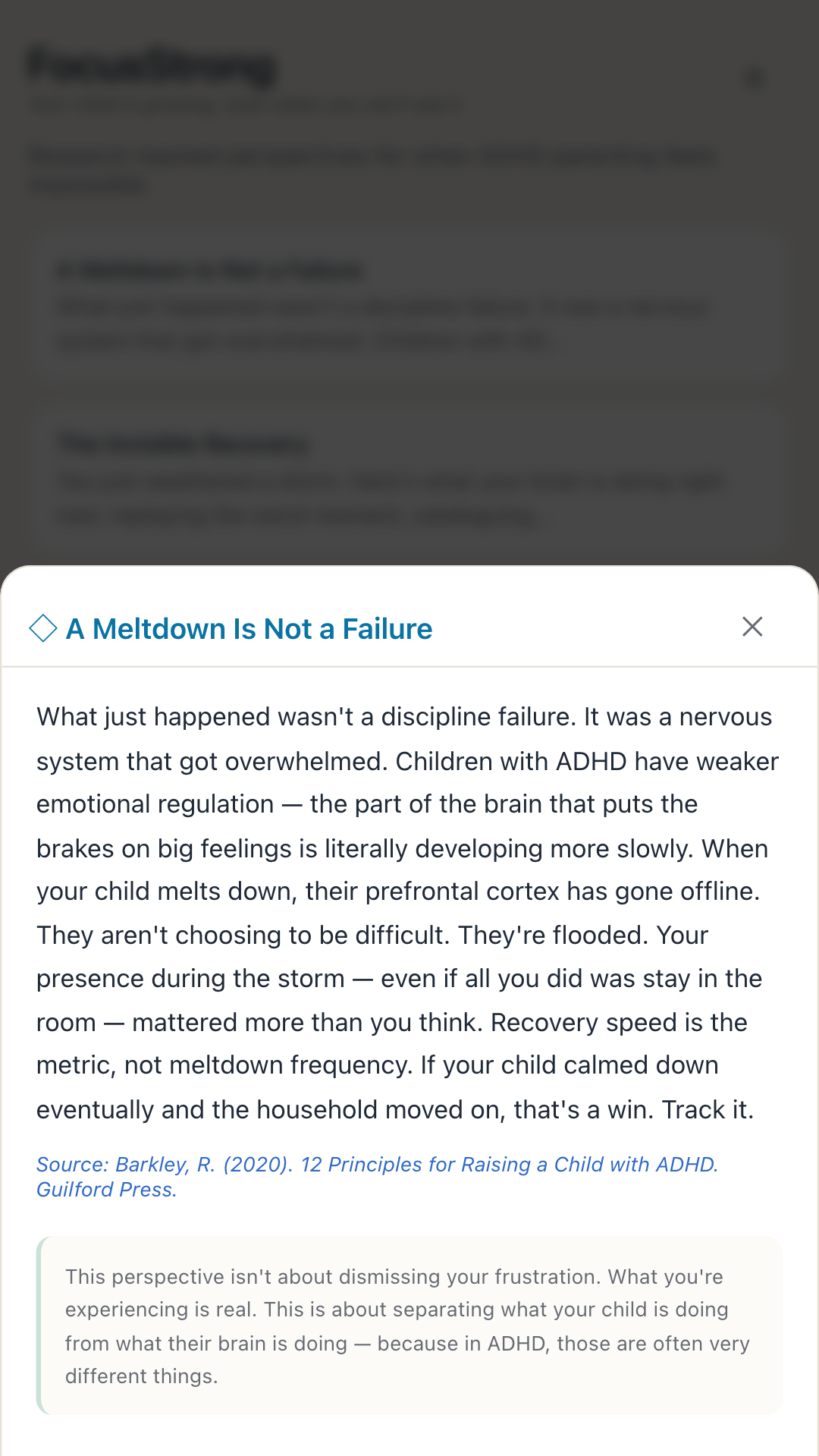
Perspective Shift cards deliver short reframes grounded in the ADHD research — on executive function, emotional regulation, developmental lag and what is and isn't under a child's control. Each card pairs the feeling you're having with what the evidence actually says.
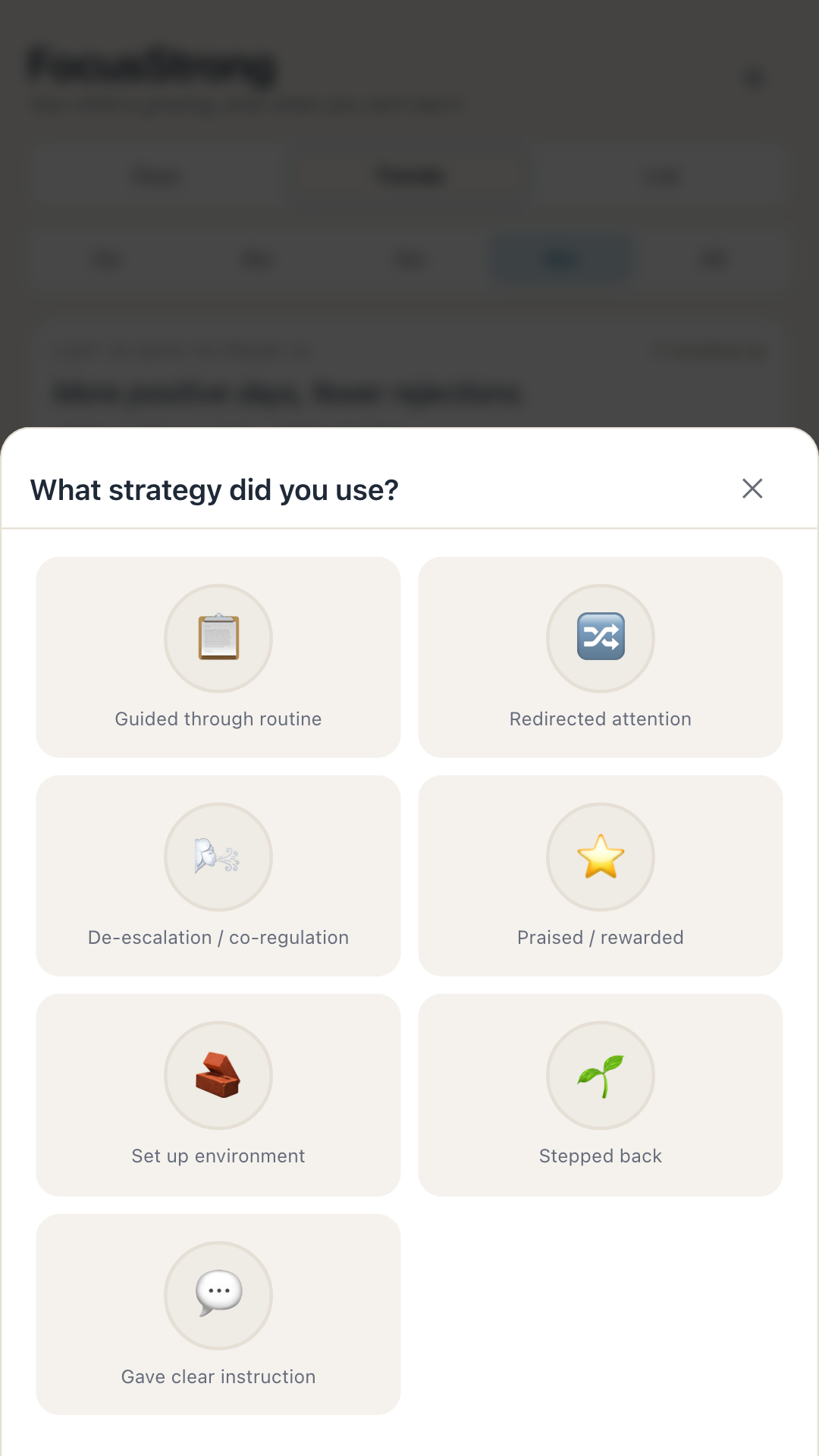
After a day of cueing, redirecting and calming, nobody has the energy for a journal. The daily check-in is 30 seconds. A handful of sliders and an optional note. That's all.
The Daily Log is designed for parents running on empty after a chaotic day. Rate a few dimensions and move on. Those 30 seconds power the Timeline, the Patterns, and the picture you can share with your paediatrician or therapist at the next appointment.
Fast enough to do on the hardest nights. That's how trends get built.
Grounded in behavioural parent training, not one more sticker chart.
All data stays on your device. No accounts, no servers, no analytics.
FocusStrong is for the parent rebuilding the same routines every day for a child whose brain keeps taking them apart.
{{^app.live}}Coming soon to Google Play
{{/app.live}}