ParkinStrong

Caregiver burden in Parkinson's disease tends to rise as symptoms progress — and is driven by more than just motor change.1 See the work that doesn't get measured.

A daily log for Parkinson's care partners — so the slow, shifting work of medication timing, off-periods and your own coping doesn't disappear into one long undifferentiated year.

1 Mosley, P. E., Moodie, R., & Dissanayaka, N. (2017). Caregiver burden in Parkinson disease: A critical review of recent literature. Caregiver burden in Parkinson's disease tends to increase as motor and non-motor symptoms progress, with psychiatric and behavioral symptoms contributing more to burden than motor decline alone.

You are tracking on/off cycles, meal timing, fall risk, sleep, mood — and a person you love watching for the smallest change. The neurologist sees them for twenty minutes every few months. You see them every waking hour. And somehow, in the appointment, none of what you noticed comes out quite right.

Meanwhile, the care you are quietly providing gets folded into the word 'spouse' or 'partner'. There is no chart for the hours you spend recalibrating the day to the medication window, no scale for the emotional work of staying warm while the role keeps shifting.

“I honestly can't tell if anything is different from three months ago.”

Parkinson's moves in small, uneven ways. A slower morning. A shorter on-period. A good walk on a day you weren't expecting one. A foggier afternoon you were. Day to day none of it registers. Over months the arc is real.

The Timeline turns your daily check-ins into a trend line across weeks and months. You'll see how off-periods, mobility, mood and your own load are moving — a picture the clinic visit cannot give you, and a record you can actually bring into the next neurology appointment.
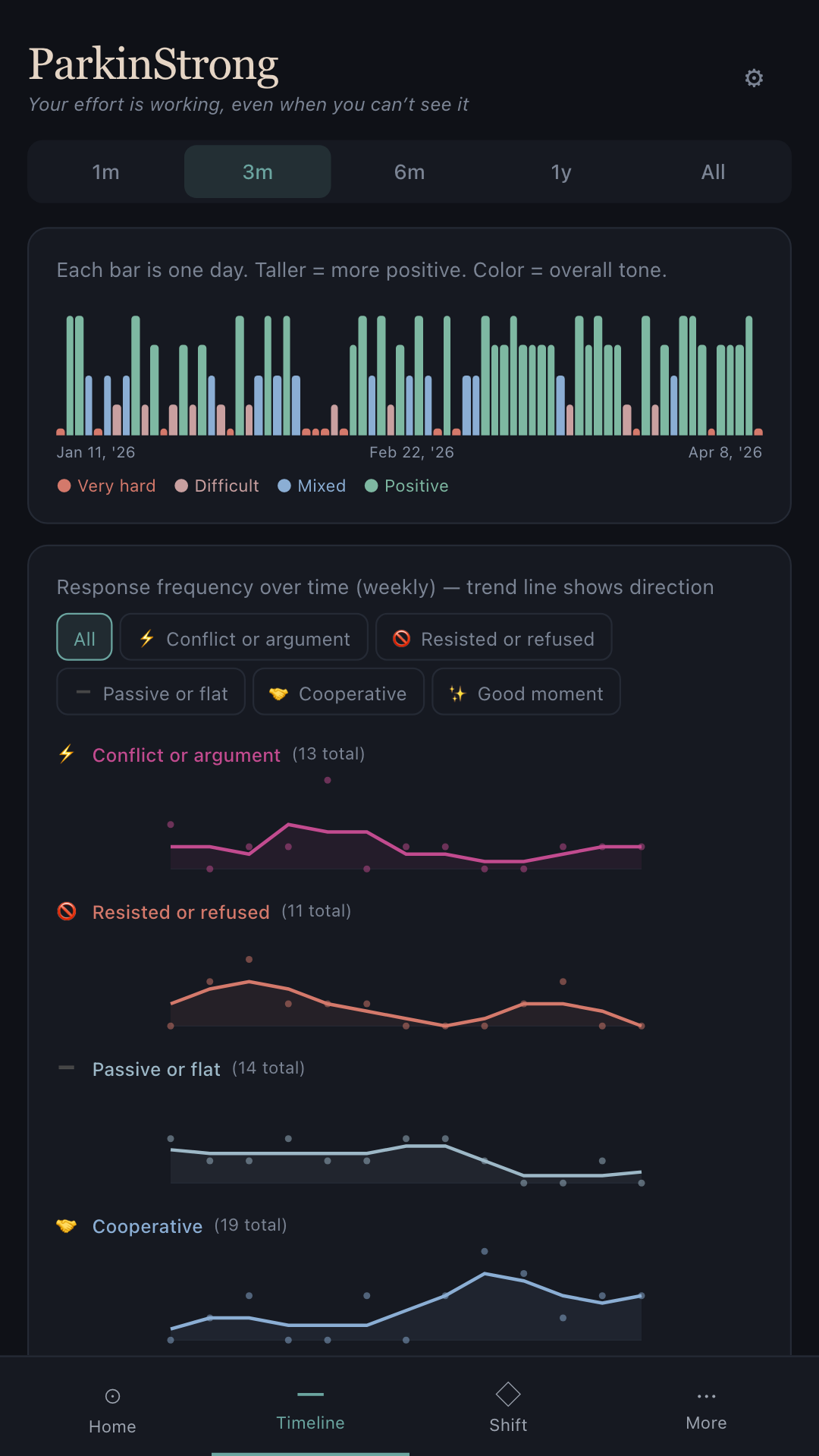
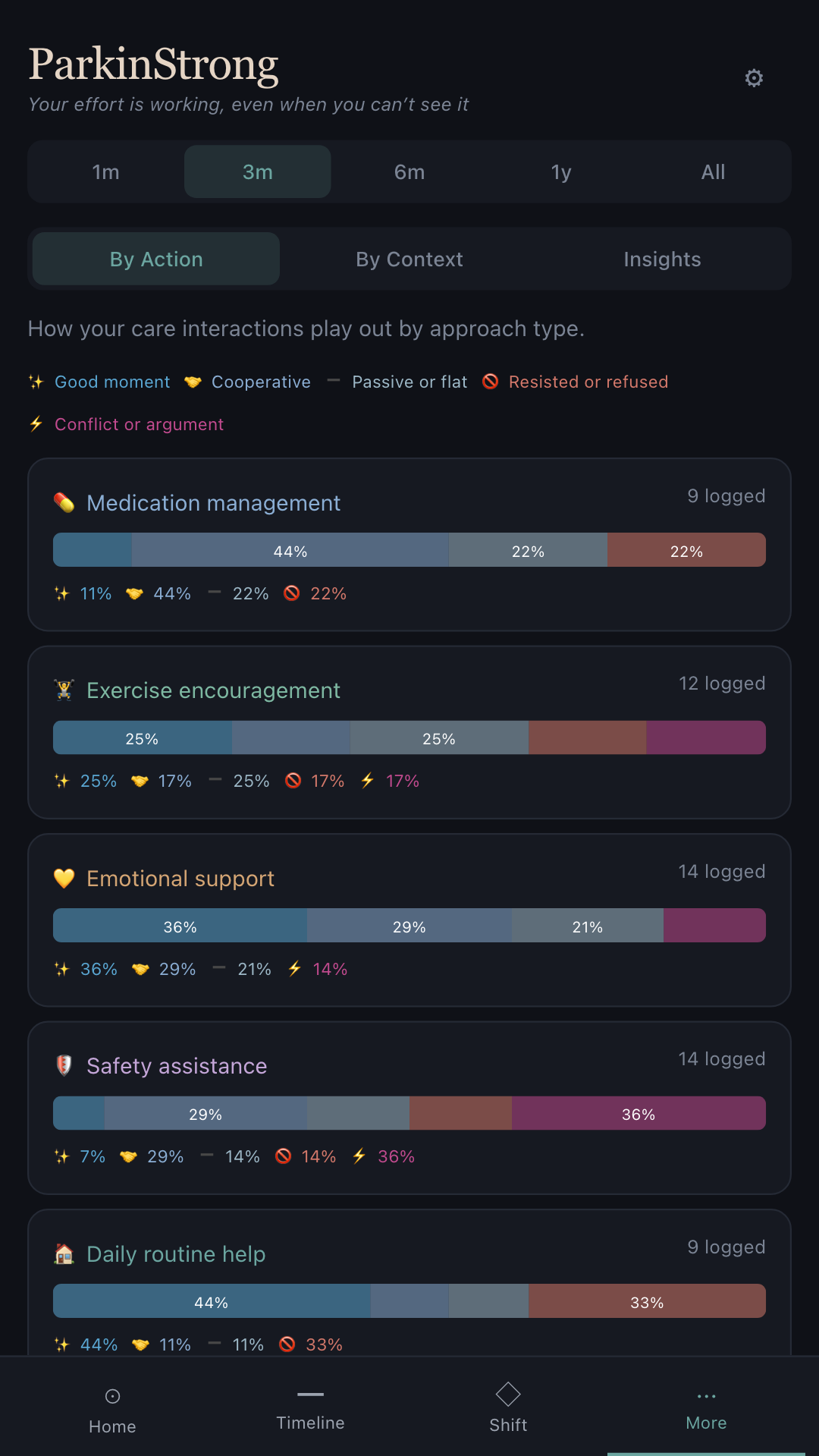
ParkinStrong Timeline screen showing off-period and caregiver load trends over months

“I don't know which of our routines is the one keeping the hard days fewer.”

You're juggling medication windows, protein timing, exercise, sleep, social contact, the physio's homework. When a good week happens, you don't know which piece earned it.

The Pattern Engine cross-references your daily entries to reveal which inputs correlate with better on-periods and easier days. Example insights might look like "mobility is better on days with an afternoon walk" or "off-periods are longer on days with late protein meals" — drawn from your own logs.

ParkinStrong Patterns screen showing correlations between routine and on-periods

“Some days I feel more like a carer than a partner, and I hate that.”

The slow slide from partner to carer is one of the quiet griefs of Parkinson's. It is real, and it isn't a failure — but it doesn't have to be the whole story. Remembering that on a hard day is almost impossible without something external.

Perspective Shift cards deliver short, research-backed reframes grounded in the Parkinson's care literature. Each card pairs what you're feeling with what researchers, clinicians and experienced care partners say about progression, connection, grief and sustainable caregiving.

ParkinStrong Perspective Shift screen showing a research-backed reframe for a Parkinson's care partner

“I already track enough medications and appointments.”

Your day is already made of reminders and spreadsheets. Anything that adds more will be quietly abandoned. The daily check-in is 30 seconds. A few sliders, an optional note, done.

The Daily Log is designed for care partners who are already tracking everything else. Rate a few dimensions and move on. Those 30 seconds power the Timeline, the Patterns, and the clear picture you can show the neurologist or your own GP.

ParkinStrong daily log screen with sliders for on-periods, mobility and caregiver load

30 seconds a day

Fast enough to do on the hardest evenings. That's how trends get built.

Honest about progression

No cure story. Just clearer visibility into a slow disease and your own work.

Private by design

All data stays on your device. No accounts, no servers, no analytics.

Built for you. Not the patient. Not the neurologist. You.

ParkinStrong is for the care partner holding the household together through a slow-moving disease — the person whose daily work the clinic never sees.

{{^app.live}}

Coming soon to Google Play

{{/app.live}}