PawStrong
A daily log for people living with a reactive dog — so months of careful under-threshold work don't get erased by one surprise encounter at the end of a lead.
1 American Veterinary Society of Animal Behavior (AVSAB) (2021). AVSAB Position Statement on Humane Dog Training. AVSAB's position is that reward-based, positive-reinforcement training methods are the evidence-based standard of care for modifying dog behavior, including fear- and reactivity-related problems.
The problem
You plan your walks around who won't be there. You scan every hedge, every parked car, every corner. You carry treats, a long line, a list of escape routes. And then someone lets their off-lead dog run up anyway, and the walk that was going well disappears behind one ten-second explosion of barking and lunging.
When a bad moment is all your memory retains, it stops feeling like behaviour modification is working. It is very easy to abandon a careful counter-conditioning protocol, give up on the vet behaviourist's plan, or start blaming yourself for a dog who was already quietly getting braver.
Reactivity improves in fractions — a longer look before a trigger, a quicker recovery after, a calmer reorientation. The bad moments are loud and your memory rewrites the rest of the week around them. Over months the direction is still real.
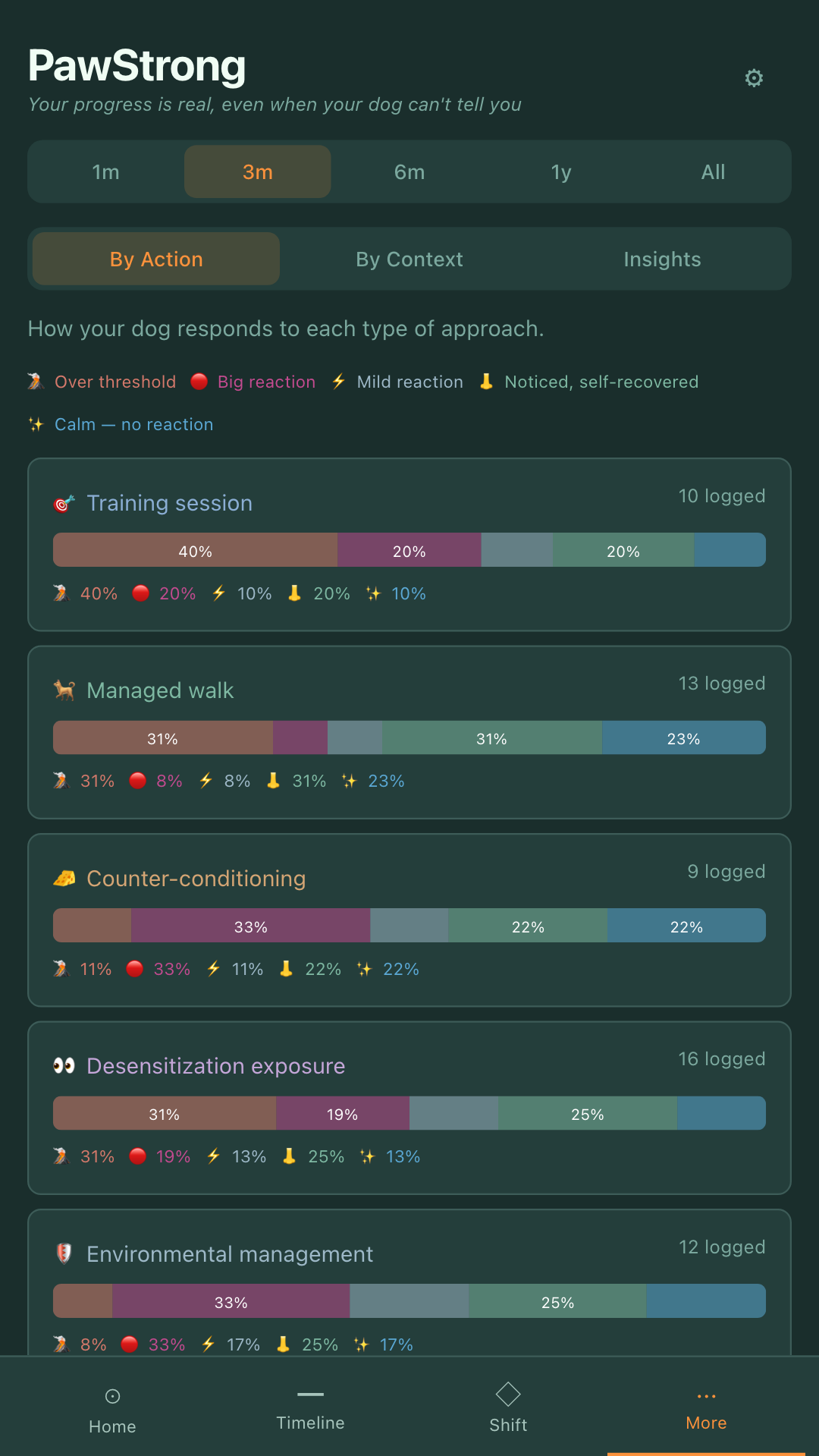
The Timeline turns your daily check-ins into a trend line across weeks and months. You'll see whether thresholds are rising, whether recovery is getting faster, whether the number of under-threshold walks is moving up — something a week of memory cannot give you.
You're running enrichment, decompression walks, pattern games, counter-conditioning sessions, management, maybe medication. When a calmer week happens, you don't know what earned it.
The Pattern Engine cross-references your daily entries to reveal which inputs correlate with calmer days. Example insights might look like "threshold is higher on mornings after a sniff walk" or "recovery is faster on days with enrichment before walks" — drawn from your own logs.
Other owners don't know that the dog straining at the end of your lead is the result of months of careful work. Absorbing their judgment on top of your own is one of the hardest parts of living with a reactive dog.
Perspective Shift cards deliver short, research-backed reframes grounded in veterinary behaviour science. Each card pairs what you're feeling with what behaviourists and the literature actually say about reactivity, thresholds, setbacks, and what progress really looks like — so one bad encounter stops being the whole story.
Anything that asks you to journal after every walk will get abandoned. The daily check-in is 30 seconds. A handful of sliders and an optional note. That's all.
The Daily Log is designed for owners who are already doing enough. Rate a few dimensions — triggers, threshold, recovery, your own state — and move on. Those 30 seconds power the Timeline, the Patterns, and a clear report you can share with your trainer or vet behaviourist.
Fast enough after the worst walks. That's how trends get built.
Grounded in the reward-based behaviour modification research, not dominance myths.
All data stays on your device. No accounts, no servers, no analytics.
PawStrong is for the person walking a reactive dog at 6 a.m. in the dark — the one doing the daily work nobody else watches.
{{^app.live}}Coming soon to Google Play
{{/app.live}}