SensoryStrong
A daily log for parents of a child with sensory processing challenges — so the slow growth in tolerance across clothes, food, sound and transitions doesn't vanish behind one bad meltdown.
1 Ahn, R. R., Miller, L. J., Milberger, S., & McIntosh, D. N. (2004). Prevalence of parents' perceptions of sensory processing disorders among kindergarten children. In a survey of parents of kindergarten-aged children, roughly 1 in 6 was reported to show sensory processing problems significant enough to affect daily functioning.
The problem
You have mapped the house like a terrain. You know which shirt can be worn, which seam is a problem, which foods are safe today and not tomorrow, which hum from the fridge sends everything sideways. You carry noise-cancelling headphones and a spare everything. And you still get blindsided.
When a meltdown hits, the weeks of quiet tolerance-building that preceded it get erased in your memory. You start wondering whether the sensory diet is worth the effort, whether the OT is right, whether you're imagining the progress you thought you were seeing.
Sensory tolerance grows in fractions: a new fabric without a tantrum, a louder room survived, a food tolerated at the edge of the plate. Day to day they evaporate. Over weeks the trend is real.
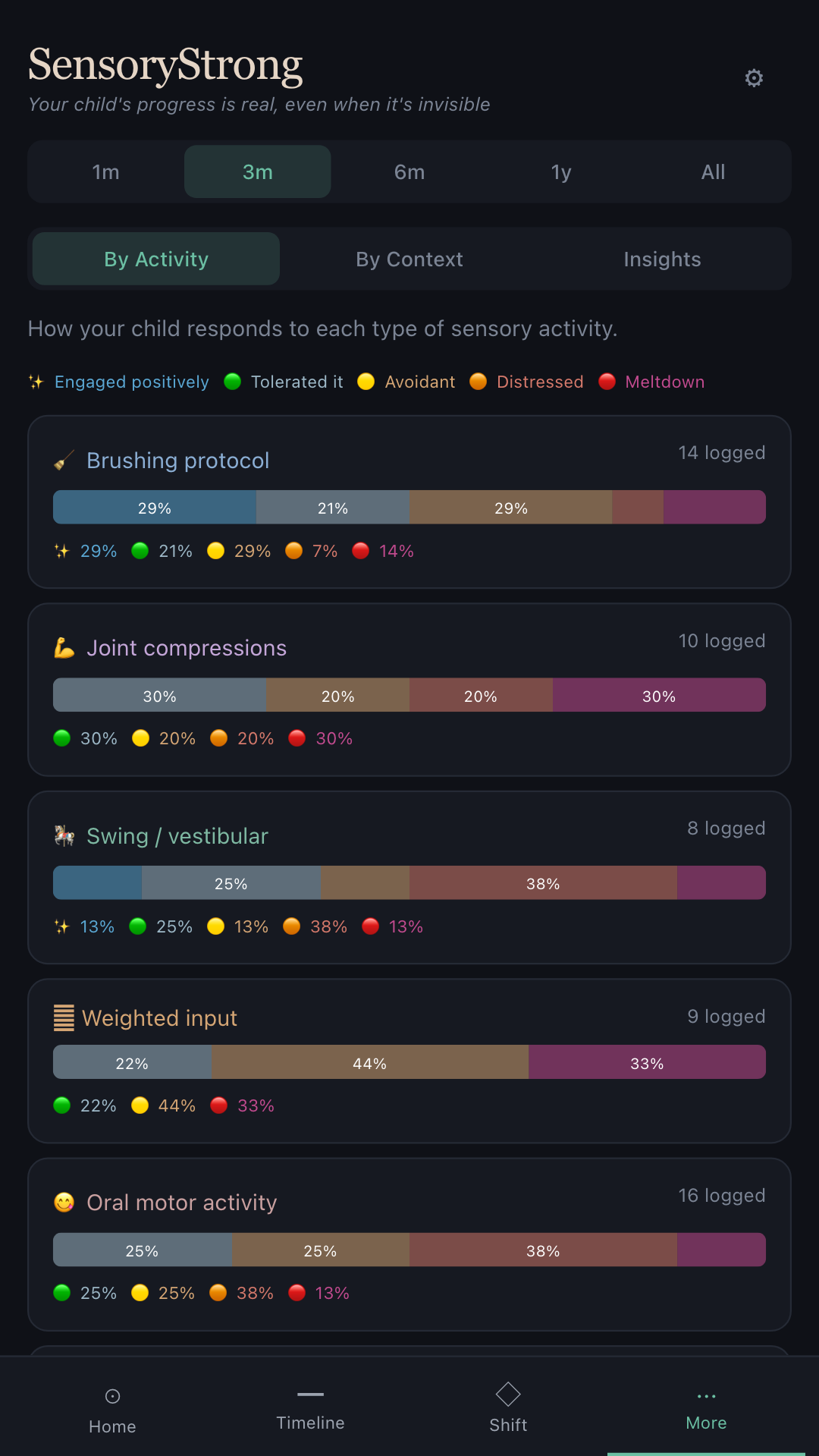
The Timeline turns your daily check-ins into a trend line across weeks and months. You'll see whether tolerance is growing, whether meltdown recovery is getting faster, whether the sensory diet is showing up in calmer afternoons — something your memory on a bad morning cannot hold.
Between brushing, compressions, swings, quiet spaces, the OT's homework, headphones, weighted this, bouncy that — there are too many moving parts to track in your head. When a calmer day happens, you don't know which piece earned it.
The Pattern Engine cross-references your daily entries to reveal which inputs correlate with calmer, more regulated days. Example insights might look like "meltdowns are less frequent on days after heavy-work activities" or "transitions are smoother after quiet-room breaks" — drawn from your own logs.
Sensory processing challenges look like defiance, look like fussiness, look like 'spoiled'. Holding onto the truth — that this is nervous system, not character — while someone else in the room is silently judging is almost impossible without help.
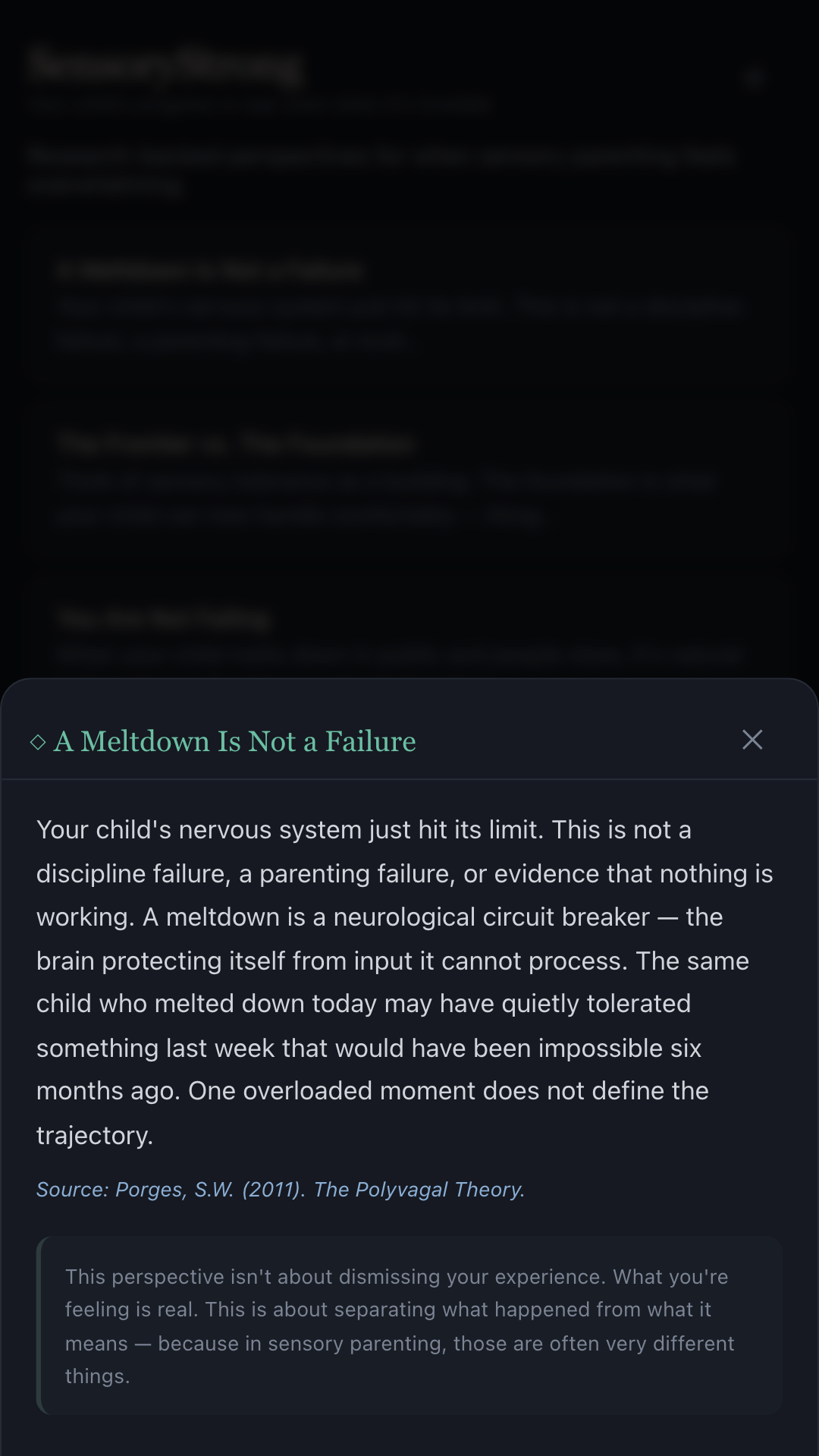
Perspective Shift cards deliver short, research-backed reframes grounded in the sensory processing and paediatric OT literature. Each card pairs what you're feeling with what the research actually says about regulation, thresholds and the shape of slow tolerance growth.
Parents of sensory kids are already tracking too much. Anything that adds another form to fill out will get abandoned. The daily check-in is 30 seconds: a few sliders, an optional note, done.
The Daily Log is designed for parents who are already carrying a lot. Rate a few dimensions — sensory load, meltdowns, tolerance, your own capacity — and move on. Those 30 seconds power the Timeline, the Patterns, and a clearer picture to bring to the OT.
Fast enough to do on the hardest evenings. That's how trends get built.
Grounded in the sensory processing and paediatric OT literature, not online advice.
All data stays on your device. No accounts, no servers, no analytics.
SensoryStrong is for the parent running a sensory diet around school, meals and bedtime — the person quietly protecting a child's nervous system all day.
{{^app.live}}Coming soon to Google Play
{{/app.live}}