StrokeStrong

Most measurable recovery after stroke happens in the first 3 to 6 months — but functional gains continue for years.1 See what's still changing.

A daily log for family caregivers of a stroke survivor — so the slow, uneven work of rehabilitation at home becomes something you can actually see across months and years.

1 Cramer, S. C. (2008). Repairing the human brain after stroke: I. Mechanisms of spontaneous recovery. Most measurable motor and functional recovery after stroke occurs in the first 3–6 months, but neuroplastic gains and functional improvement can continue for months and years with ongoing rehabilitation.

You are running rehab in your living room. You are the one cueing speech practice, watching for another TIA, checking the meds, listening to the therapist's instructions, and holding the hand that still shakes at the dinner table. You're also the one who lives with the survivor every hour — which is exactly why the small daily gains have stopped registering.

When you can't see the arc of recovery, it becomes easy to quietly give up on exercises that are working, to mistake plateaus for the end, and to arrive at the next rehab review with a story that doesn't match the data. The caregiver who is doing the daily work deserves a picture of the whole month, not just the hardest hour of it.

“I honestly can't tell if anything is still getting better.”

Post-stroke recovery happens in centimetres. A cleaner word. A steadier step. A slightly stronger grip on the handrail. A quieter mood in the afternoon. Day to day it blurs. Over months the arc is still real.

The Timeline turns your daily check-ins into a trend line across weeks and months. You'll see whether motor, speech, mood and caregiver load are moving in the direction you hoped — a picture the rehab team can use, and one you can trust on the days you've lost your own.

StrokeStrong Timeline screen showing recovery trends across motor, speech and mood

“I don't know which of the exercises is actually earning these gains.”

You're running speech practice, physio homework, medication timing, sleep protection, cognitive cueing and your own coping. When a good week happens, you don't know which piece made the difference.

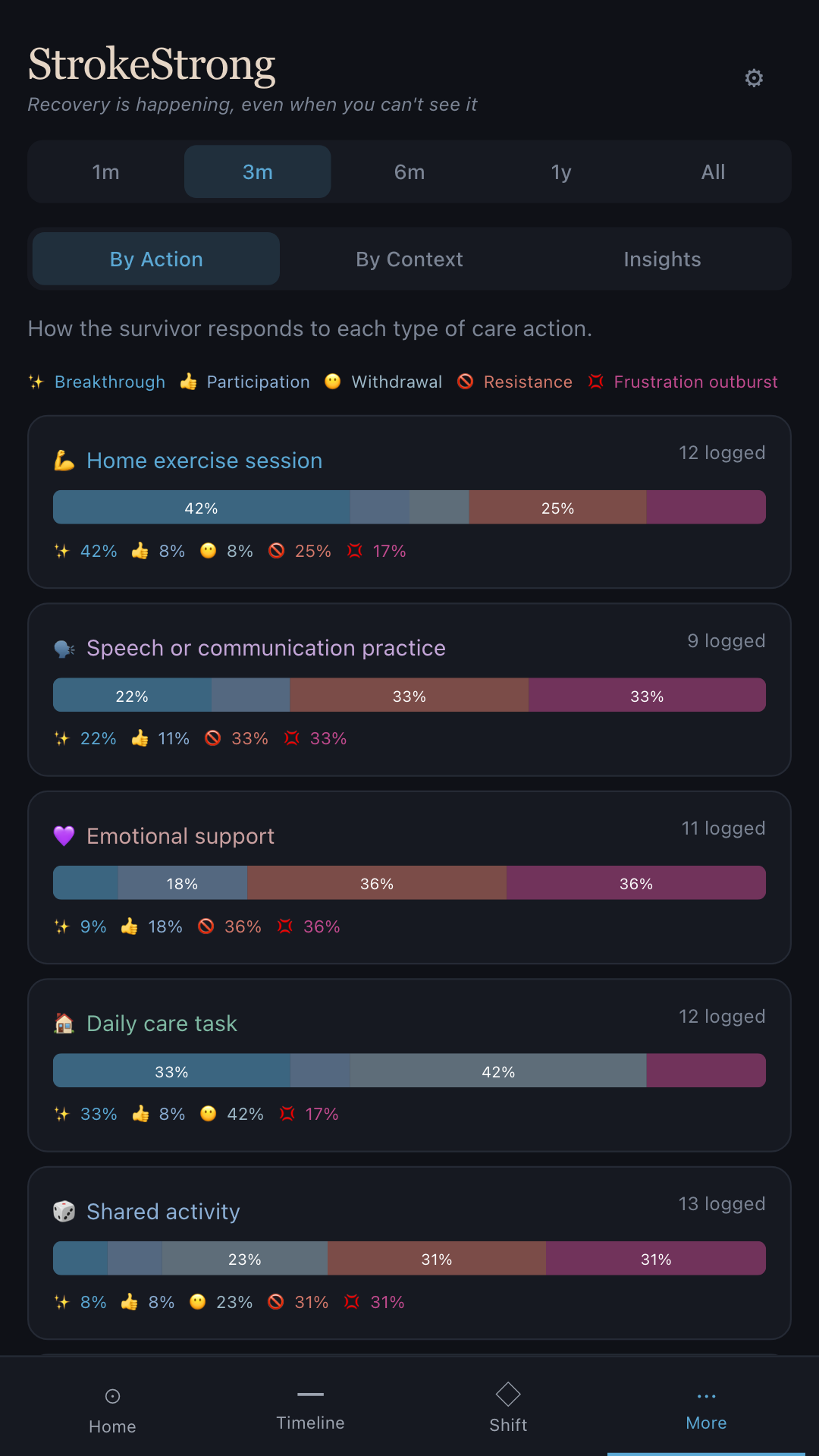
The Pattern Engine cross-references your daily entries to reveal which inputs correlate with better days. Example insights might look like "speech clarity is higher the day after a rest day" or "mood dips on days following poor sleep" — drawn from your own logs.

StrokeStrong Patterns screen showing correlations between rehab routines and recovery

“He said something I don't think he would have said before.”

Irritability, short temper, flat mood, emotional lability — these are common after a stroke, and they are injury effects, not personality. Holding that in mind mid-conversation is almost impossible without help.

Perspective Shift cards deliver short, research-backed reframes grounded in the stroke recovery literature. Each card pairs what you're feeling with what researchers and clinicians say about post-stroke mood, cognition, behaviour and the long, uneven shape of real recovery.

StrokeStrong Perspective Shift screen showing a research-backed reframe for a stroke caregiver

“I'm already tracking meds, appointments and exercises.”

Stroke caregivers already live in spreadsheets and reminders. Anything that adds more will be abandoned. The daily check-in is 30 seconds. A few sliders, an optional note, done.

The Daily Log is designed for caregivers running on empty. Rate a few dimensions — motor, speech, mood, your own load — and move on. Those 30 seconds power the Timeline, the Patterns, and the clear picture you can bring to the next rehab review or neurology visit.

StrokeStrong daily log screen with sliders for motor, speech, mood and caregiver load

30 seconds a day

Fast enough to do after a hard night. That's how trends get built.

Grounded in rehab research

Built on the stroke recovery literature, not cure narratives.

Private by design

All data stays on your device. No accounts, no servers, no analytics.

Built for you. Not the survivor. Not the rehab team. You.

StrokeStrong is for the family caregiver running rehab in the living room every day — the person whose work the clinic only sees for an hour at a time.

{{^app.live}}

Coming soon to Google Play

{{/app.live}}