StutterStrong

Roughly 75–80% of children who begin to stutter in early childhood recover naturally or with therapy.1 See the fluency through the fluctuation.

A daily log for parents of a child who stutters — so the natural day-to-day fluctuation in fluency stops hiding the real trend underneath.

1 Yairi, E., & Ambrose, N. (2013). Epidemiology of stuttering: 21st century advances. Longitudinal research indicates that roughly 75–80% of children who begin to stutter in early childhood recover naturally or with therapy, though daily fluency varies widely day-to-day.

One day your child is speaking in full, confident sentences. The next day every word seems to hit a wall. You know the literature says fluency fluctuates, but knowing and feeling it are different things — and when a hard day arrives, your brain is convinced that every previous good day was a fluke.

Without a clearer picture, parents quietly start to change their environment in ways that don't help: finishing sentences, rushing past blocks, correcting, coaching. The child starts to sense concern, and the concern itself becomes part of the pattern. The daily work you're trying to do gets lost in the noise.

“He was so fluent last week. Today it's like none of it ever happened.”

Fluency moves up and down day by day in almost every child who stutters. A single hard morning can wipe the memory of a good week. Over months the underlying trend is still there, and it is still almost always the most important signal you have.

The Timeline turns your daily check-ins into a trend line across weeks and months. You'll see fluency, your child's confidence and the communication environment at home as a picture you can actually read — instead of a feeling you have to trust on a bad day.
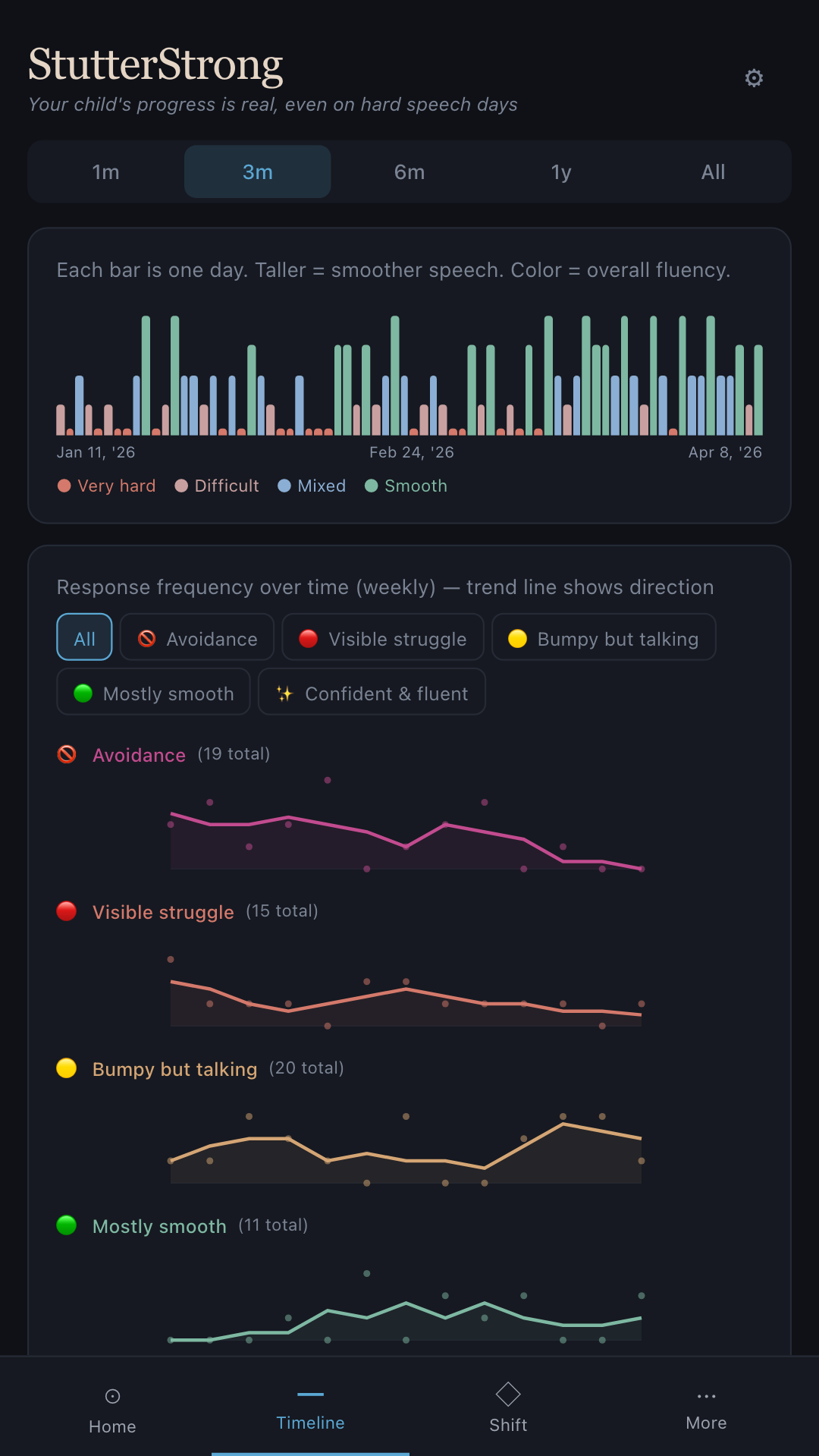
StutterStrong Timeline screen showing fluency and confidence trends across months

“I don't know which of our habits is actually helping him speak.”

The research points to slow pace, open questions, plenty of wait time and unhurried mealtime conversation. But between busy mornings, school runs and three people trying to speak at once, it's hard to tell which habits are actually present in your house.

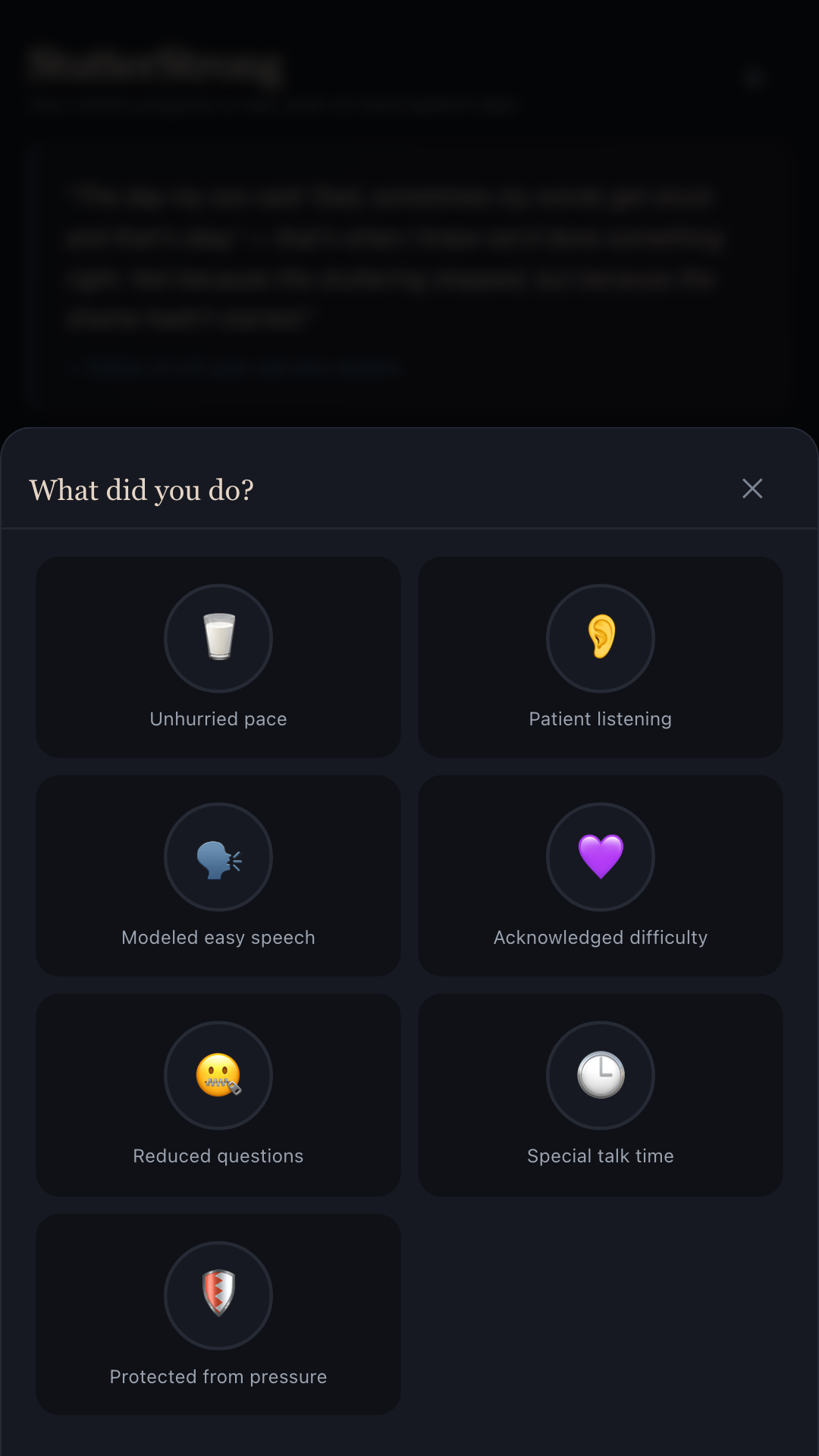
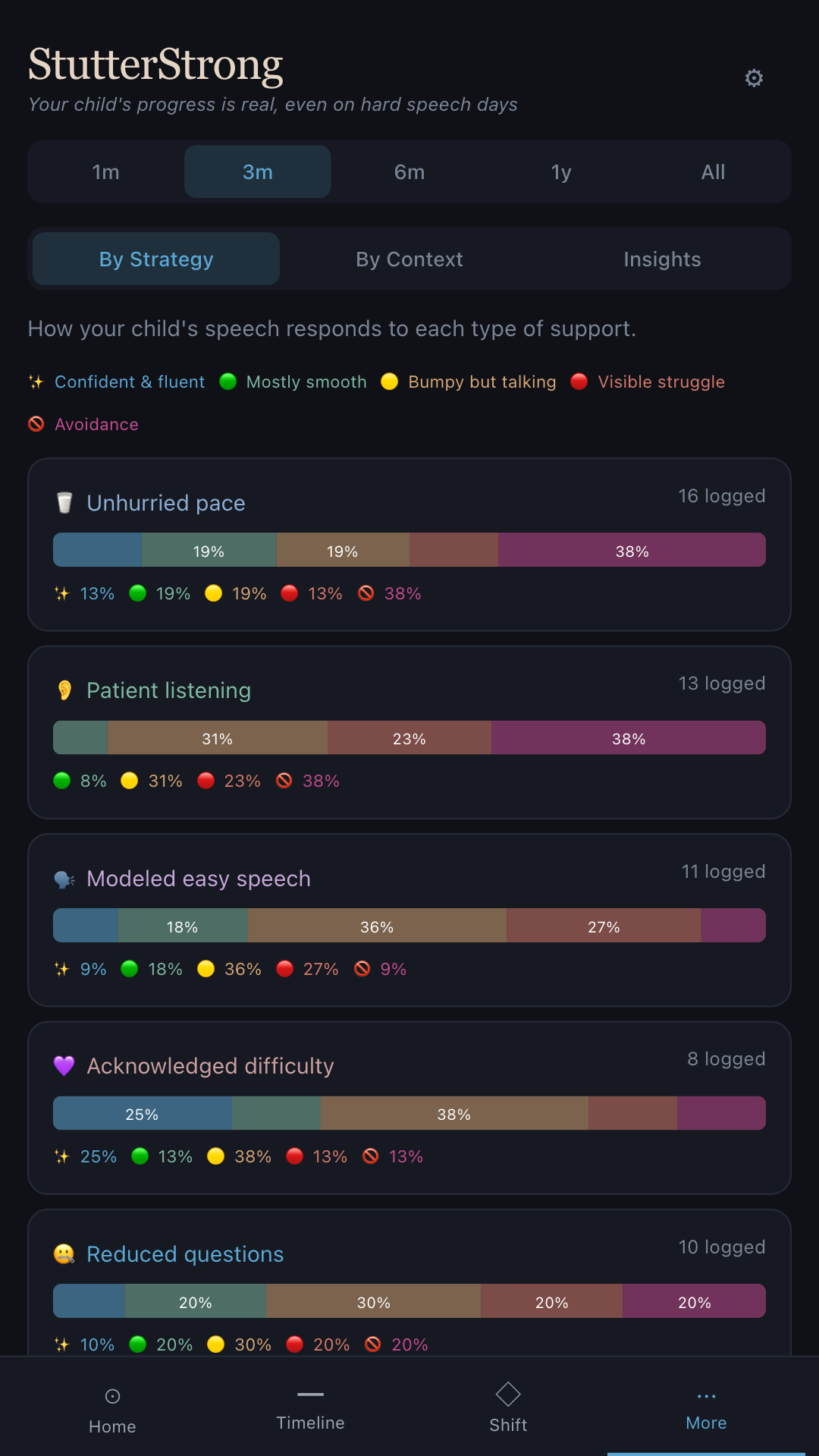
The Pattern Engine cross-references your daily entries to reveal which environment inputs correlate with better fluency days. Example insights might look like "fluency is higher on days after unhurried meals" or "blocks are more frequent on days with lots of rapid questions" — drawn from your own logs.

StutterStrong Patterns screen showing correlations between home environment and fluency

“I'm scared he's starting to notice.”

The biggest risk in childhood stuttering is rarely the stutter itself — it's the story a child starts to tell themselves about speaking. Holding your own reactions steady, week after week, is one of the most protective things a parent can do.

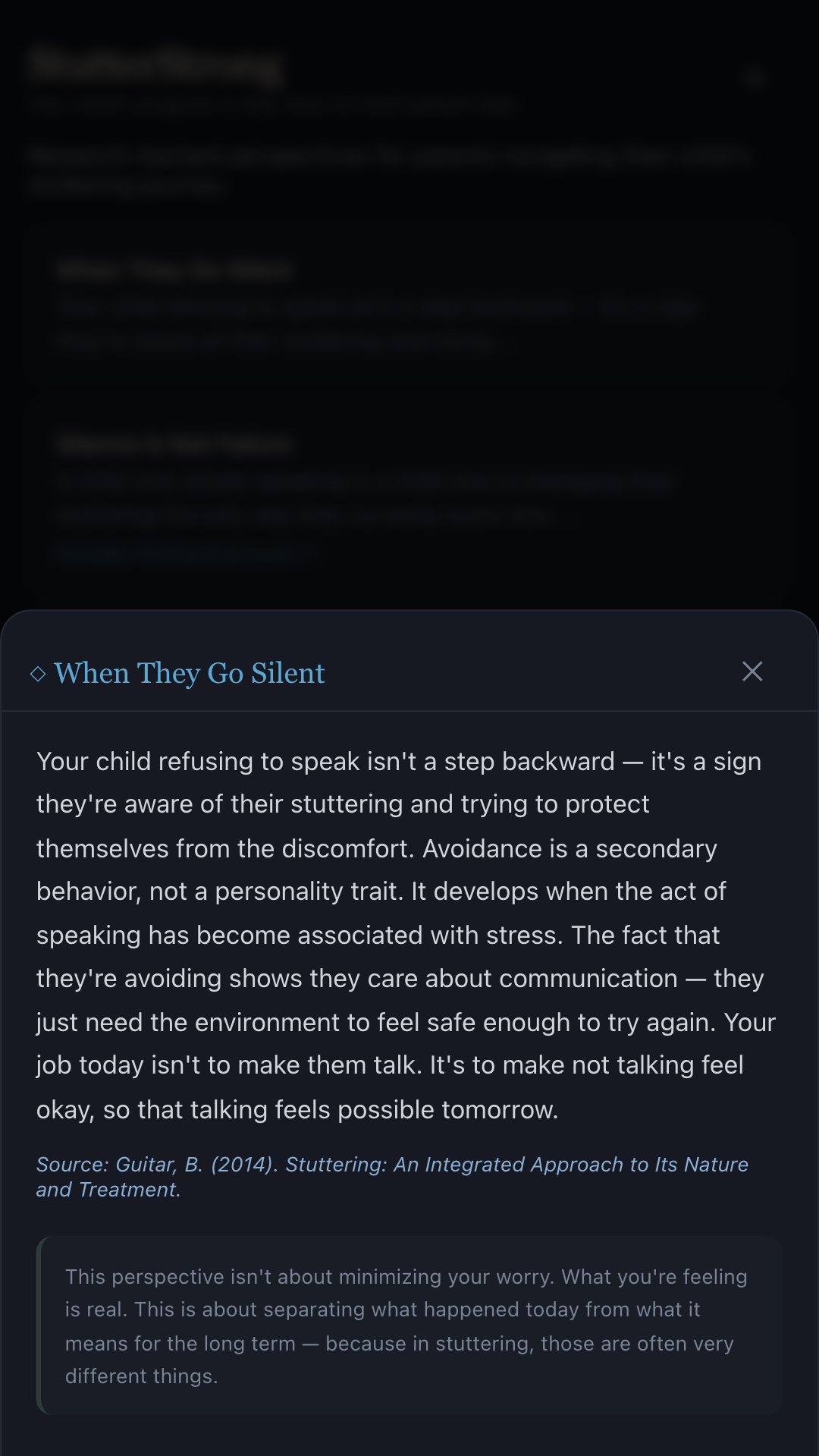
Perspective Shift cards deliver short, research-backed reframes grounded in the stuttering literature. Each card pairs what you're feeling with what researchers and SLTs actually say about fluctuation, recovery, parent reactions and the communication environment — so the worry in your stomach stops leaking into your voice.

StutterStrong Perspective Shift screen showing a research-backed reframe for a parent of a child who stutters

“I can't stop and write about every sentence he gets stuck on.”

Journaling every block is both impossible and unhelpful. The daily check-in is 30 seconds. A few sliders — fluency, confidence, environment, your own reaction — and an optional note.

The Daily Log is designed for parents who just want the signal. Rate a few dimensions and move on. Those 30 seconds power the Timeline, the Patterns, and the clear picture you can share with your speech and language therapist at the next review.

StutterStrong daily log screen with sliders for fluency, confidence and communication environment

30 seconds a day

Fast enough to do on the hardest speaking days. That's how trends get built.

Built on the research

Grounded in the stuttering and fluency literature, not generic advice.

Private by design

All data stays on your device. No accounts, no servers, no analytics.

Built for you. Not the speech therapist. Not the teacher. You.

StutterStrong is for the parent protecting the communication environment at home — the person doing the part of therapy that happens at every meal.

{{^app.live}}

Coming soon to Google Play

{{/app.live}}